
 Give Today

Year-end conversations, a charitable advising tune-up, and women and wealth | Advisor Newsletter (November 2026)
November is here, and year-end planning is in full swing! As you help clients wrap up 2026 and prepare for the year ahead, the Community Foundation of Southern Indiana is here to support you. Whether you’re navigating charitable giving strategies, exploring new opportunities, or simply looking for a trusted resource, you can count on our team to help.
This month, we’re sharing a few timely insights to help strengthen your conversations with clients. Sometimes, a single question can open the door to meaningful charitable planning opportunities. We’re also exploring new research on what motivates donors, practical ways to strengthen your approach to charitable advising, and the growing role women play in shaping family philanthropy.
Of course, while trends and strategies may change, our commitment to you and your clients remains the same. For more than 35 years, the Community Foundation has been a trusted partner in helping individuals and families make a lasting difference. That same experience, personal attention, and dedication to our community will continue to guide our work today, tomorrow, and for generations to come.
Thank you for making the Community Foundation your first call when charitable giving matters cross your desk. We value your trust, appreciate the relationships we’ve built, and look forward to continuing our work together.
As always, please reach out anytime. We’re here to help!
Article #1: A Single Question Makes It Easy to Help Clients with Year-End Giving
One simple question can open the door to meaningful conversations about philanthropy, whether a client has retired, welcomed a grandchild, experienced a jump in income, or become more involved in the community.
Article #2: Timing Matters! Important 2026 Year-End Dates for Giving
As 2026 comes to a close, there is still time for your clients to make a meaningful difference in our community through a year-end gift to the Community Foundation of Southern Indiana.
Article #3: Start, Stop, and Continue: Your Charitable Advising Tune-Up
Are you bringing your “A game” to charitable planning? New research reveals some surprising gaps between what advisors think motivates their clients to give and what clients actually say.
Article #4: CFSI Releases Enhanced, More User-Friendly Fillable QCD Form
Now it’s even easier for your clients to expediate the process of establishing a designated pass-through fund using a Qualified Charitable Distribution (or IRA Rollover) gift. Click the button below to check it out.
Article #5: Women and Wealth: Strengthening Relationships Through Planning
Women are playing an increasingly important role in financial decision-making, and new research offers valuable insights into what female clients want from their advisors.
Article #6: CFSI Offering $2-for-$1 Match on Gifts to Community Impact Fund
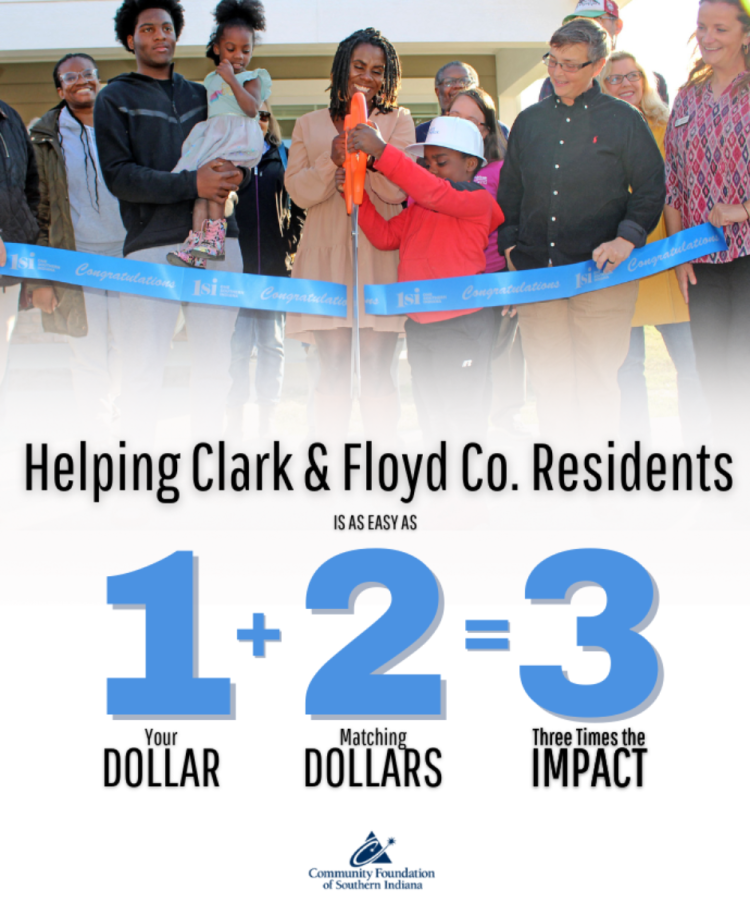
Individuals, families, and businesses can make an even greater investment in the future of Clark and Floyd counties through a new $2-for-$1 matching opportunity to permanently strengthen local grantmaking.
A Single Question Makes It Easy to Help Clients with Year-End Charitable Giving

by Linda Speed, President & CEO
The days are getting shorter – and year-end is getting closer! Of course, year-end is always a busy time for financial, tax, and estate planning advisors. Between reviewing investment portfolios, evaluating tax strategies, and helping clients prepare for the coming year, there’s plenty to cover. You may wonder how on earth you’ll find the bandwidth to also meet with clients about charitable giving.
Fortunately, charitable giving doesn’t have to be a separate conversation. In fact, some of the most productive charitable planning discussions begin with a question you’re probably already asking:
“How did your life change in 2026?”
Listen carefully to a client’s answer to this question. Does the client mention retirement? Unexpectedly high income? A new grandchild? Joining a favorite nonprofit’s board of directors? These are just a few examples of developments that can create opportunities for charitable planning. Here’s how:
Retirement
If a client mentions retirement, you could ask: “Do you plan to get more involved with your favorite causes?” This opens the door to helping the client plan for their charitable giving over the next few years, and perhaps even updating an estate plan or beneficiary designation to include a charitable gift through their estate plan to a donor-advised fund at the community foundation or another charitable organization. What’s more, a discussion about retirement is a natural lead-in to helping clients age 70½ or older explore the benefits of Qualified Charitable Distributions (QCDs) from their IRAs. QCDs can’t go to donor-advised funds, but they can support other funds at the community foundation, such as field-of-interest or unrestricted funds. Reach out to the community foundation for more information about QCDs.
High income
If a client mentions that their income was higher this year than expected, it makes sense to ask: “Are you considering increasing your charitable giving?” If the client says yes, you can provide more detail on year-end planning techniques that could help your client achieve their philanthropic goals alongside financial goals. In many cases, the community foundation offers tools and resources to help achieve these goals, so please reach out to our team.
Growing family
If a client tells you about a new grandchild, you could ask: “As your family grows, have you thought about ways to pass along your values and philanthropic priorities to the next generation?” You can go even deeper by suggesting that a donor-advised fund at the community foundation can provide a structure for involving family members in giving decisions, supporting favorite causes together, and passing along philanthropic values. The team at the community foundation regularly works with families across generations to make a difference in the community. Please loop us in; we are here to support you as you serve your clients.
Expanding community involvement
If a client tells you about joining a nonprofit’s board of directors, you could ask: “Does this new role change how you think about your charitable giving plan?” If the client says yes, the easiest thing to do is suggest bringing the community foundation into the conversation. “The community foundation is a terrific resource and sounding board for anything related to philanthropy,” you can say. “I’ll reach out to my contact at the community foundation and suggest that the three of us jump on a 15-minute call or Zoom next week.”
As always, the community foundation is happy to help. Whether you’re looking for ideas to start a conversation, exploring a particular charitable planning strategy for a specific client, or anything in between, we’re here to serve as a resource for you and your clients.
Timing Matters! Important 2026 Year-End Giving Dates for Your Clients

by Linda Speed, President & CEO
As 2026 comes to a close, there’s still time for your clients to make a meaningful difference in our community through a year-end gift to the Community Foundation of Southern Indiana (CFSI). Whether they’re supporting a cause close to their heart or investing in the future of Clark and Floyd counties, their generosity can make a lasting impact.
If they are planning to make a charitable contribution before the end of the year, a little preparation can go a long way! The timing of their gift matters, particularly when it comes to qualifying for a charitable tax deduction in 2026.
Different giving methods, including checks, stocks, and credit cards, have different rules for determining when a gift is officially made. We’ve outlined a few important dates and guidelines below to help you and your clients plan ahead and ensure their generosity counts toward the 2026 tax year.
What Changed in 2026
The One Big Beautiful Bill Act, enacted in 2025, changed the charitable deduction starting with the 2026 tax year:
- A deduction for non-itemizers. Donors who take the standard deduction can now deduct up to $1,000 ($2,000 for married couples filing jointly) in qualifying cash gifts to eligible charities. Gifts of stock, and contributions to donor-advised funds or supporting organizations, don’t qualify.
- A 0.5% floor for itemizers. Charitable deductions now count only above 0.5% of the donor’s adjusted gross income. At $200,000 of AGI, the first $1,000 of total annual giving isn’t deductible for 2026.
- A 35% cap for top-bracket donors. Donors in the 37% bracket now see the tax value of their itemized deductions, charitable gifts included, capped at about 35 cents per dollar.
Key Year-End Deadlines at a Glance
A gift counts for 2026 only if it’s complete by December 31. December 25 falls on a Friday and December 31 on a Thursday, and many offices close early. Please plan accordingly.
| Gift Type | What Counts by December 31 | Suggested Start Date |
| Appreciated Stock | Shares reach the charity’s account | Friday, December 11 IMPORTANT: If you sell the shares and give the proceeds to charity, you will be liable for capital gains tax on the sale. |
| IRA – Qualified Charitable Distribution | Funds leave the donor’s IRA, paid directly to an eligible charity | To ensure your QCD counts for 2026, we strongly recommend initiating it ASAP and confirming timing with your IRA administrator. |
| Credit Card | The charge is made | Thursday, December 31 |
| Check by U.S. Mail | Mailed by December 31; the check may clear in January | Mail by mid-December and keep proof of mailing. Postmarks may reflect the processing date; for late mailings, ask for a manual postmark, a Postage Validation Imprint (PVI), or a Certificate of Mailing |
| Check by FedEx, UPS, DHL | Received by the charity | Shipping by December 31 is not enough |
| Wire Transfer | Funds reach the charity | Friday, December 11 |
| ACH or online bank payment | Payment is completed | Scheduling on December 31 may not be enough |
Grant Distributions: Monday, December 14
Due to the high volume of December grant distributions, we recommend submitting grant recommendation by Monday, December 14 to ensure they are processed before the end of the year.
For more information on year-end giving, please visit our webpage by clicking here.
“Start, Stop, and Continue”: Your Charitable Advising Tune-Up

by Kathy Watkins, Director of Gift Planning
The world of tax, financial, and estate planning is changing rapidly. Indeed, accounting professionals are well aware of these dynamics: 86% expect AI to increase their ability to deliver advisory work over the next 12 months, and 44% want their firms to be known for growth-focused advisory by 2030, according to a 2026 Intuit QuickBooks survey of 725 U.S. accounting professionals.
What’s more, philanthropy is becoming central to wealth management, especially as $18 trillion is expected to flow to charitable causes over the next few decades of generational wealth transfer, according to Cerulli Associates, creating opportunities for advisors to connect financial planning with clients’ values, family relationships, and legacy goals.
So – are you bringing your “A game” to this opportunity? Here’s a quick three-part “start, stop, and continue” tune-up to help you enhance your work with charitable clients.
Start asking what clients want their giving to accomplish.
It can be tempting to begin a charitable planning conversation with tools like donor-advised funds, charitable trusts, QCDs, appreciated stock, and the tax benefits associated with each. But new research suggests that starting with the “why” may be more important.
The 2026 Study of the Philanthropic Conversation from The Philanthropic Initiative (TPI) found a few eye-opening gaps between what advisors think motivates high-net-worth clients and what clients themselves say. Advisors, for example, ranked “being an inspiration for others” as the most common motivation for giving, cited by 51%. Among clients, this factor ranked only 11th out of 12 motivations, at just 24%. In addition, advisors were nearly twice as likely as clients to identify reducing taxes as an important motivation – 40% versus 21%. Clients instead put making an impact, feeling good about giving, and giving back at the top of the list.
If you aren’t already doing so, start your charitable conversations with a question: “What would you like your charitable giving to accomplish?”
The answer may lead to a tax strategy, a particular giving vehicle, a family conversation, or something else entirely. As always, the team at the community foundation is honored to be your first call as a charitable giving resource. We can help you explore what matters to your client and then work with you to identify charitable strategies that fit.
Stop steering clients toward “too good to be true” charitable giving arrangements.
A few months ago, the U.S. Department of the Treasury and IRS issued final regulations identifying certain abusive charitable remainder annuity trust (CRAT) arrangements as “listed transactions,” triggering disclosure requirements for certain participants and their advisors.
The specific type of transactions targeted by these regulations generally involve transferring appreciated property to a purported CRAT, selling the property, using the proceeds to purchase a single premium immediate annuity, and then misapplying tax rules in an effort to avoid ordinary income or capital gains taxes. The IRS emphasized that it will continue to scrutinize these arrangements and that failure to comply with required disclosures may result in penalties.
“I doubt I’ll ever set up a CRAT in my entire career,” you may be thinking. Which may absolutely be the case! The point is that CRAT regulations are just one example in a long line of situations where the IRS has cracked down on abusive charitable giving arrangements. If you are ever tempted to implement trendy and aggressive techniques, stop. Pausing for a moment to call the community foundation for a gut check may be a wise move to protect your clients and protect yourself.
Continue bringing the family into the conversation.
Here’s something you may already be doing – and the latest research offers a compelling reason to keep doing it.
The same 2026 TPI study found that 95% of advisors believe discussing philanthropy is important for building relationships with clients’ extended families, up from 71% in 2018. Clients see the value, too: 78% of high-net-worth clients said including extended family members in philanthropic conversations is important. And there is a business-development benefit. Eighty-eight percent of advisors said philanthropic conversations deepen existing client relationships, while 92% said they help establish new relationships.
Meanwhile, ultra-high-net-worth Americans (those with a net worth of $30 million or more) donated approximately $107 billion to charity in 2025, according to Altrata’s High Net Worth Philanthropy 2026 report, as reported by InvestmentNews – reflecting the growing importance of philanthropy in wealth management and estate planning. The same TPI study also reveals a disconnect between clients and advisors: 75% of high-net-worth clients say they would be more likely to select an advisor who is knowledgeable about philanthropy, yet only 45% of advisors say they discuss philanthropy with most of their clients, according to InvestmentNews. As younger generations inherit significant wealth and embrace charitable giving, advisors who incorporate philanthropy into their practices may be better positioned to strengthen client relationships and retain families across generations.
So keep talking about philanthropy – and look for opportunities to widen the conversation. A discussion about the causes a client cares about can provide a natural, low-pressure way to bring children and grandchildren into the room, learn what matters to them, and begin building relationships across generations.
The community foundation can help here, too. Whether the goal is involving the next generation, establishing a family giving tradition, or simply helping clients articulate what they want their philanthropy to accomplish, we’re happy to join you in the conversation. We look forward to hearing from you!
CFSI Releases Enhanced, More User-Friendly Fillable QCD Form

by Linda Speed, President & CEO
Now it’s even easier for your clients to expediate the process of establishing a designated pass-through fund using a Qualified Charitable Distribution (or IRA Rollover) gift.
Last week, the Community Foundation of Southern Indiana released an enhanced, more user-friendly fillable QCD Form on its website. The completed form will be used to complete your fund agreement.
Using the information in the form you submit, the Community Foundation will send a draft fund agreement to your email for review and signature. (As a reminder, to comply with the law, no gift should be made until the final, signed fund agreement is received by the Foundation.)
At that time, your clients can instruct you to process their Qualified Charitable Distribution and to deliver it directly to the Community Foundation of Southern Indiana (tax ID 35-1827813) at 4108 Charlestown Road, New Albany, IN 47150.
If at any time you have questions, please contact Kathy Watkins at 812-948-4662 ext 9 or kwatkins@cfsoutherindiana.com.
Women and Wealth: Strengthening Relationships Through Planning

by Kathy Watkins, Director of Gift Planning
Women are playing an increasingly influential role in wealth management, and new research suggests that advisors have an opportunity to strengthen relationships by paying closer attention to what female clients want from financial advice. According to Vanguard’s 2026 Women & Wealth Study, 76% of women feel confident making financial decisions, and women rank educational and collaborative as their top two preferred communication styles from a financial professional.
Meanwhile, a recent AdvisorHub article highlights the growing importance of planning that connects financial decisions with broader goals as women assume greater responsibility for family wealth.
For advisors, charitable giving offers a particularly effective way to build these relationships. Philanthropy can open conversations about personal priorities, family dynamics, and long-term goals that might not otherwise emerge during a traditional financial planning meeting.
Here are three suggestions for incorporating charitable giving into your approach to working with women clients.
Ask about charitable interests before introducing charitable planning tools.
Rather than beginning with tax deductions, donor-advised funds, or charitable trusts, consider asking what causes matter most to your client and what she hopes her giving will accomplish. Perhaps she has a longstanding relationship with a local nonprofit, wants to address an emerging community need, or is interested in supporting a cause that reflects her personal experiences. These conversations can help you better understand her priorities before recommending a particular strategy. The community foundation can be a valuable resource, offering insights into local charitable organizations, community needs, and giving opportunities that align with your client’s interests.
Make charitable planning a collaborative process.
Research suggests that women value financial expertise while also wanting to participate actively in decisions. Indeed, InvestmentNews reported on a Nationwide survey finding that although 95% of women investors believe their advisors treat them with the same respect as male clients, nearly one-third reported experiencing patronizing explanations of financial concepts. Charitable planning provides an opportunity to demonstrate a more collaborative approach. Consider presenting several giving options, explaining the advantages and limitations of each, and inviting your client to help shape the strategy. Whether she is evaluating a gift of appreciated stock, establishing a donor-advised fund, or considering a charitable provision in her estate plan, the community foundation can join the conversation to help explore options and answer questions.
Use philanthropy to engage the entire family.
A recent Fortune article highlights how younger members of billionaire families are pushing their parents and grandparents to accelerate charitable giving and embrace more innovative, impact-driven approaches to philanthropy, including addressing systemic problems, empowering communities, and making a difference during donors’ lifetimes rather than waiting to distribute wealth through their estates.
Charitable giving can also provide a natural opening for conversations about family relationships and the transfer of wealth and values across generations. For clients who want to involve children or grandchildren in philanthropy, a donor-advised fund or another charitable fund at the community foundation can offer a practical framework for making giving decisions together. These conversations may be especially valuable when a woman assumes greater responsibility for family financial decisions after retirement, an inheritance, or the loss of a spouse. Indeed, building relationships before major wealth transitions is essential. The community foundation can help families explore shared charitable interests, develop giving traditions, and create opportunities for multiple generations to participate.
Of course, every client is different, and charitable giving should always reflect an individual’s interests and goals rather than assumptions based on gender. The larger lesson from recent research is that women want advisors who listen, provide expertise, and recognize their role as informed financial decision-makers.
By incorporating philanthropy into these relationships, advisors can gain a deeper understanding of what matters to their clients while helping them translate their values into meaningful charitable action. The community foundation is always happy to serve as a resource, working alongside you and your clients to explore opportunities for charitable giving that support both financial and personal goals.
CFSI Offering $2-for-$1 Match on Gifts to Community Impact Fund
by Linda Speed, President & CEO
For more than three decades, Lilly Endowment’s Giving Indiana Funds for Tomorrow (GIFT) initiative has shaped how Indiana communities understand and respond to local needs. With the arrival of the next GIFT initiative, called GIFT IX, up to $271.5 million will be made available statewide to strengthen community foundations and enhance quality of life across the state.
Beginning January 1, 2026, Lilly Endowment will provide a $2 match for every $1 gift made to any unrestricted endowed funds, including the Community Impact Fund, through June 30, 2028.
Why is this important to our community?
Southern Indiana donors demonstrated the power of collective philanthropy during our previous matching opportunity, contributing more than $1.5 million that generated a total of more than $4.5 million in permanent charitable resources for the Community Impact Fund through matching dollars. Those endowed assets continue to support grants that strengthen local nonprofits and improve quality of life throughout Clark and Floyd counties.
As community needs continue to grow and evolve, this new matching opportunity allows donors to build on that momentum while expanding the Foundation’s ability to respond to future challenges. GIFT IX has the potential to significantly impact our community for many years to come. Building our unrestricted endowment will allow us more flexibility and a greater capacity to address critical needs as they arise in our community.
Areas where unrestricted grants are used:
- Arts and Culture
- Community Development
- Education
- Environment
- Health and Human Services
- Recreational
- Religion
- Scholarships
- Youth Development
Disclaimer: The Community Foundation of Southern Indiana is a resource and sounding board as you serve your philanthropic clients. We understand the charitable side of the equation and are happy to serve as a secondary source as you manage the primary relationship with your clients. This newsletter is provided for informational purposes only. It is not intended as legal, accounting, or financial planning advice.