
 Give Today
Dual strategies for charitable clients, transferring a private foundation, and a bear market case study | Advisor Newsletter (April 2026)
Thank you for the opportunity to work together. We are grateful for the many conversations we continue to have with attorneys, CPAs, and financial advisors as you help your clients navigate charitable planning in a rapidly evolving environment. It is a privilege to support your efforts to align your clients’ philanthropic goals with their broader financial and estate plans.
As tax policy and market conditions continue to shift, many of you are seeing new dynamics emerge in your client conversations. Our team is closely monitoring these trends so we can share timely insights and practical ideas to support your work.
- Serving Charitable Clients: As charitable planning becomes more nuanced, your clients are increasingly falling into two distinct groups. Ultra-high-net-worth individuals are navigating sophisticated, long-term strategies tied to legacy and wealth transfer, while clients earlier in their careers are engaging in charitable giving for the first time, often encouraged by new incentives. Understanding these differences can help you tailor your approach.
- 23rd Annual Professional Advisor Seminar: The Community Foundation of Louisville, together with the CFSI, is proud to continue a regional tradition of bringing professional advisors together for high‑quality charitable planning education. The seminar is complimentary and designed specifically for advisors serving clients with charitable interests.
- Private Foundation Transfer: For clients with private foundations, simplifying the structure may be top of mind. Transferring assets to a donor-advised fund at the community foundation can reduce administrative burdens, but a thoughtful transition – including proactive communication with nonprofit grantees – is essential to maintaining strong relationships and continued community impact.
- Case Study: The possibility of a sustained down market can influence how clients think about giving. A case study highlights how you can help clients stay focused, identify tax-efficient opportunities such as gifts of appreciated stock, and remain responsive to increasing community needs during uncertain times by working with the community foundation.
- April SIEPC Event: You’re invited to attend the Southern Indiana Estate Planning Council’s final meeting of 2025-26 as our guest, which features Hon. J. Terrence Cody speaking on “2026 Probate, Estate, and Trust Legislation”. The event will take place on Tuesday, April 14. The seminar is FREE, but seating is limited and advanced registration by Friday, April 10 is required to reserve lunch. One hour of CLE credit for Indiana is also available at no cost. Guests are welcome to attend one meeting; continued participation requires membership in the SIEPC.
Thank you for your continued partnership. Please consider the community foundation to be your first call whenever the topic of charitable giving arises. We look forward to working with you.
Serving Charitable Clients: Dual Strategies Emerge

by Linda Speed, President & CEO
As tax laws and market dynamics continue to shift, it is important for attorneys, CPAs, and financial advisors to be aware of two increasingly distinct groups of donors. On one hand, the high federal estate tax exemption and new restrictions on itemizing charitable deductions are creating unique needs for your clients whose assets exceed $30 million. On the other hand, the new charitable deduction for non-itemizers offers an entry point and incentive for your clients who are just starting out in their careers or still building wealth.
Recent research underscores just how pronounced this divide is becoming. Individuals with a net worth of $30 million or more – often referred to as ultra-high-net-worth donors – are playing an increasingly outsized role in philanthropy, accounting for a significant and growing share of total charitable giving. At the same time, policy changes are encouraging broader participation at the other end of the spectrum, bringing new donors into the fold even if their initial gifts are modest. The result is a philanthropic landscape that is simultaneously becoming more concentrated and more expansive.
For your ultra-high-net-worth clients, charitable giving is rarely about a single transaction. Instead, it is often deeply integrated into long-term planning around wealth transfer, business succession, and family legacy. These clients may be evaluating complex assets, timing considerations, and multigenerational involvement. Conversations tend to focus on strategy – how philanthropy aligns with identity, values, and long-term impact. The community foundation can help you navigate these discussions by offering flexible structures, local insight, and support for engaging the next generation in meaningful ways.
By contrast, clients earlier in their wealth-building years – including the children and grandchildren of ultra-high-net-worth clients – may be engaging with charitable giving in a more incremental and exploratory way. The availability of a charitable deduction for non-itemizers creates a new opportunity to introduce philanthropy as part of their financial lives sooner than in the past. For these clients, the focus is often on establishing habits, identifying causes, and understanding how giving fits alongside other priorities. Even relatively small gifts can serve as the foundation for lifelong philanthropic engagement. (Note that the new deduction for non-itemizers applies only to cash gifts and is not available for gifts to donor-advised funds.)
These two groups are not just separated by wealth – they are operating under different incentives, different planning horizons, and different motivations. As a trusted advisor, recognizing these distinctions can help you tailor your conversations and add value in more meaningful ways. Some clients may benefit from sophisticated planning strategies, while others simply need a clear and accessible entry point.
Here is one final but important point: Regardless of whether a client itemizes or doesn’t itemize, pay close attention to clients who are age 70 ½ and over and who own IRAs. Qualified Charitable Distributions are a powerful and tax-advantaged tool for clients to transfer up to $111,000 per taxpayer (2026 limit) to support favorite causes. What’s more, proposed legislation may open the door for your clients to use QCDs to fund their donor-advised funds at the community foundation. Right now, clients can use QCDs to fund field-of-interest, unrestricted funds, and certain other types of funds at the community foundation, but not donor-advised funds.
As always, the community foundation is here to support both ends of this spectrum. Whether your client is structuring a complex gift involving closely held assets or taking the first steps toward organized charitable giving, our team can help you identify the right approach. We are honored to be your partner in serving your charitable clients across every stage of their philanthropy journey.
You’re Invited: 23rd Annual Professional Advisor Seminar
by Linda Speed, President & CEO
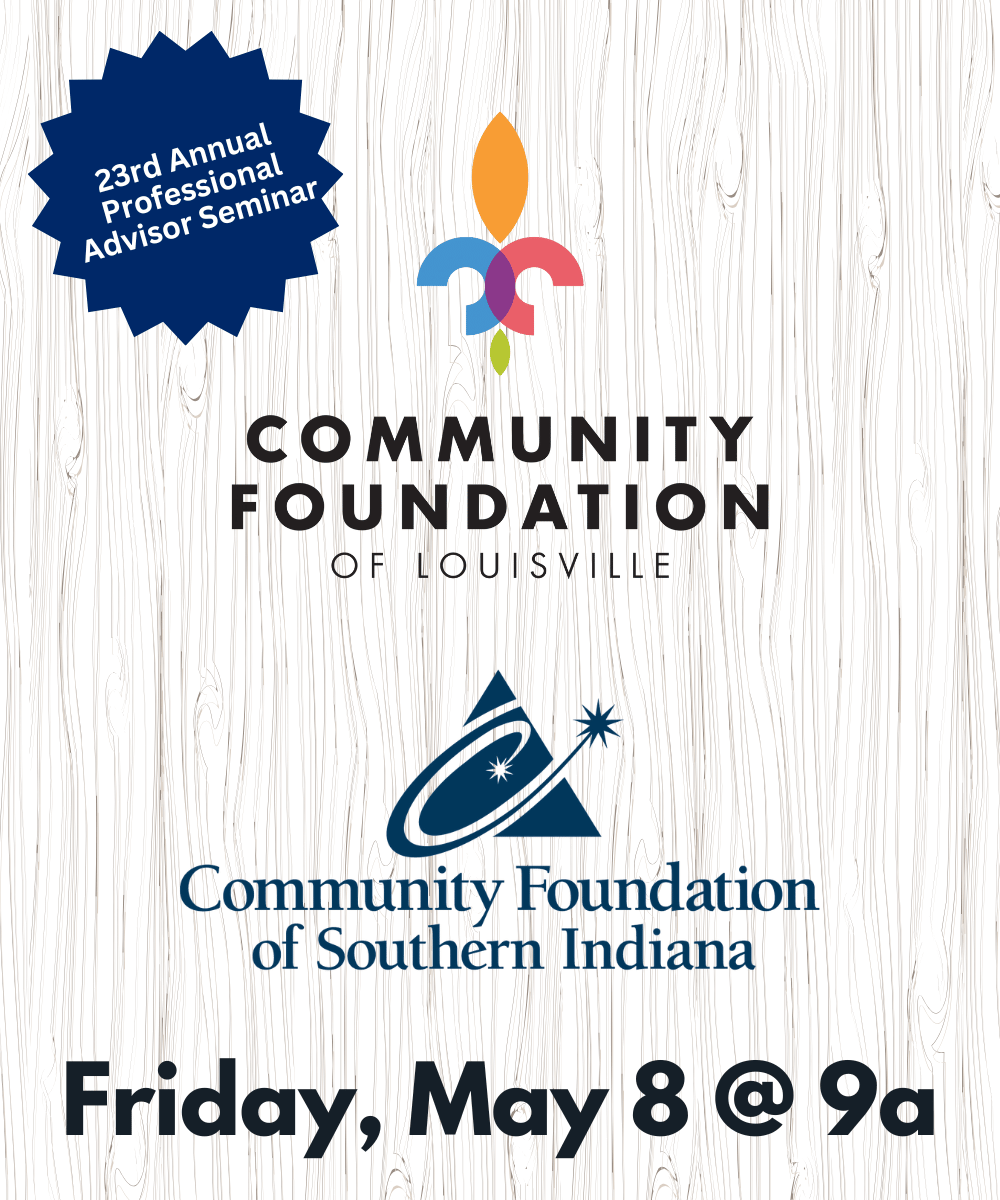
The Community Foundation of Louisville, together with the Community Foundation of Southern Indiana, is proud to continue a regional tradition of bringing professional advisors together for high‑quality charitable planning education.
The 2026 program, How to Have Charitable Conversations with Your Clients, will feature keynote speaker Cherian Koshy, author of the bestselling book Neurogiving: The Science of Donor Decision‑Making. Sessions will explore how advisors can approach charitable conversations as a fiduciary practice, using language that supports clients’ values while maintaining professional objectivity.
Highlights of the morning will include:
- Networking and breakfast
- Practical guidance on initiating charitable conversations without leading or directing
- Celebration of this year’s Wilson Wyatt Award winner
- Sharing real‑world case studies
The seminar is complimentary and designed specifically for professional advisors serving clients with charitable interests. We hope to see you there!
Friday, May 8, 2026
Registration: 8:30 a.m. – 9:00 a.m.
Program: 9:00 AM – Noon
Location: University of Louisville Shelby Campus – Founders Union Conference Center (450 N Whittington Pkwy, Louisville, KY 40222)
Transferring a Private Foundation? Remind Clients to Communicate

by Linda Speed, President & CEO
As you work with clients who have established a private foundation, it is not uncommon for the conversation to eventually turn to whether this structure still makes sense. What began as a seemingly logical vehicle for organizing a family’s philanthropy can, over time, become administratively burdensome, especially as leadership transitions to the next generation. In many cases, transferring a private foundation’s assets to a donor-advised fund at CFSI can offer a simpler and more flexible path forward.
You may already be familiar with the general benefits of a donor-advised fund. A donor-advised fund can reduce administrative responsibilities, eliminate many of the complex tax compliance requirements, and allow families to focus more fully on their charitable goals rather than ongoing operations. The technical mechanics of making the transition are also relatively straightforward, such as:
- Confirm that the private foundation’s board has approved the termination and documented the decision appropriately.
- Establish a donor-advised fund at the community foundation, often structured to mirror the private foundation’s name and governance approach.
- Grant the bulk of the private foundation’s remaining assets to the new fund, leaving a reserve to cover final expenses.
- Satisfy outstanding liabilities and complete the private foundation’s final tax filings and state-level dissolution requirements.
While these steps are important, the transition is ultimately about more than mechanics. It is an opportunity to reposition the family’s philanthropy for the future – reducing administrative friction while preserving, and in many cases enhancing, the impact of the family’s giving.
One aspect of the transition deserves particular attention because it is easy to overlook: communication with grantees. For many private foundations, relationships with nonprofit organizations have developed over years – sometimes decades. In some cases, grantees may rely on annual or recurring support.
When a private foundation winds down, a lack of clear communication can create confusion or uncertainty for the organizations that have come to depend on that funding. As a trusted advisor, you can play an important role in helping your client plan for this transition thoughtfully. What’s more, the community foundation can serve as a sounding board. Our team has close relationships with hundreds of nonprofit organizations in our community.
Here are five tips for a client’s communication plan that you can help develop with the support of the community foundation team:
- Encourage your client to communicate early and clearly with key grantees. Your client does not want nonprofits to hear about the transition from anyone else.
- The communication itself does not need to be complicated. A straightforward email message explaining that the private foundation is transitioning to a donor-advised fund – and that the family remains committed to charitable giving – can go a long way.
- Importantly, if possible, the client should reach out personally to each nonprofit grantee to let them know that they will be receiving email communication. This is not just a nice touch; it is a powerful way to maintain and deepen trust.
- If the client intends to continue supporting certain organizations, it is helpful to reassure those nonprofits that future grants may be recommended through the community foundation.
- Messages can also affirm the mission of the community foundation and the broader resources and network it provides to both your clients and the nonprofits they’ve supported for many years.
As always, we are here to help you and your clients navigate both the technical and relational aspects of this process. Whether your client is ready to move forward now or simply beginning to explore options, our team is honored to work alongside you to ensure a smooth and thoughtful transition to support your clients’ charitable objectives.
Case Study: Charitable Giving in a Down Market

by Linda Speed, President & CEO
As you guide clients through ongoing market uncertainty, you may be noticing that conversations are becoming as much about perspective as performance metrics. While headlines may or may not ultimately signal a prolonged downturn, the mere possibility of a bear market can influence how clients think about everything from retirement timelines to charitable giving. As an advisor, you have an opportunity to help clients stay grounded and intentional, even when emotions are running high.
Consider this scenario.
When David and Laura arrive at your office for their annual planning meeting, the tone feels different from prior years. In their early 70s and recently retired, David and Laura have always approached financial decisions with a long-term mindset. But today, Laura opens the conversation with a note of concern.
“We’re not panicking,” she says, “but it’s hard to ignore what’s going on in the markets. It just feels unsettled.”
You nod. You’ve been hearing similar sentiments from many clients. Even when portfolios remain relatively strong, uncertainty alone can create stress. Studies have consistently shown that financial concerns weigh heavily on emotional well-being across generations, and market volatility tends to amplify those feelings.
As you walk through David and Laura’s portfolio and estate plan, the numbers tell a reassuring story. Their overall financial plan is still on track, and their estate plan still reflects their goals. But you recognize that this moment calls for more than reassurance. It is an opportunity to reframe how charitable giving fits into the broader picture.
“You’ve both been incredibly consistent in your support of local organizations,” you say. “Tell me how you’re feeling about giving this year.”
David pauses. “We still want to give,” he says. “We just don’t want to make a mistake if the market gets worse.”
That hesitation is familiar. Rather than pulling back entirely, many clients simply need a way to move forward with confidence.
You start with a simple reminder.
“Not all stocks are down.”
You point to a portion of their portfolio that has performed well over time. These appreciated positions present an opportunity. By contributing long-term appreciated stock to their donor-advised fund at the community foundation, David and Laura may be able to avoid capital gains tax while supporting the causes they care about. Even in a volatile market, this strategy remains one of the most efficient ways to give.
Laura leans in. “So even now, that still makes sense?”
“It often does,” you reply. “And it can give you flexibility. You can make the gift now, receive the tax benefits, and then take your time recommending grants.”
The conversation begins to shift. Instead of focusing solely on uncertainty, David and Laura are now thinking about options.
You also gently raise another point.
“Market cycles come and go, but community needs don’t pause.”
You explain that periods of economic strain often increase demand for nonprofit services, particularly for households already feeling the effects of inflation and rising costs. The community foundation is closely connected to these needs and can help ensure that their giving is as impactful as possible.
Finally, you mention a strategy they have not yet used.
“Because you’re both over 70 ½, we should also look at Qualified Charitable Distributions from your IRAs.”
You walk them through how a QCD could satisfy required minimum distributions while avoiding income tax on those amounts. For clients in their stage of life, it is a straightforward and effective way to continue supporting charitable priorities regardless of market conditions. “You can direct your QCDs to certain types of funds at the community foundation,” you explain. “You can’t use them to add to your donor-advised fund (at least not yet), but you can support the community foundation’s strategic priorities to help the whole region thrive.”
By the end of the meeting, David and Laura feel a renewed sense of clarity. They decide to move forward with a gift of appreciated stock to a donor-advised fund and explore a QCD over the summer to avoid the year-end rush. Just as importantly, they feel reassured that their charitable giving does not need to stop simply because the market feels uncertain.
Situations like this are increasingly common. Even the possibility of a downturn can shape client behavior, but it can also open the door to meaningful planning conversations and help keep charitable giving going strong across our community. As always, the community foundation is here to help you navigate these discussions – offering practical strategies, local insight, and support for your clients’ charitable goals in every type of market environment.
Upcoming SIEPC Presentation: Hon. J. Terrence Cody on 2026 Probate, Estate, and Trust Legislation
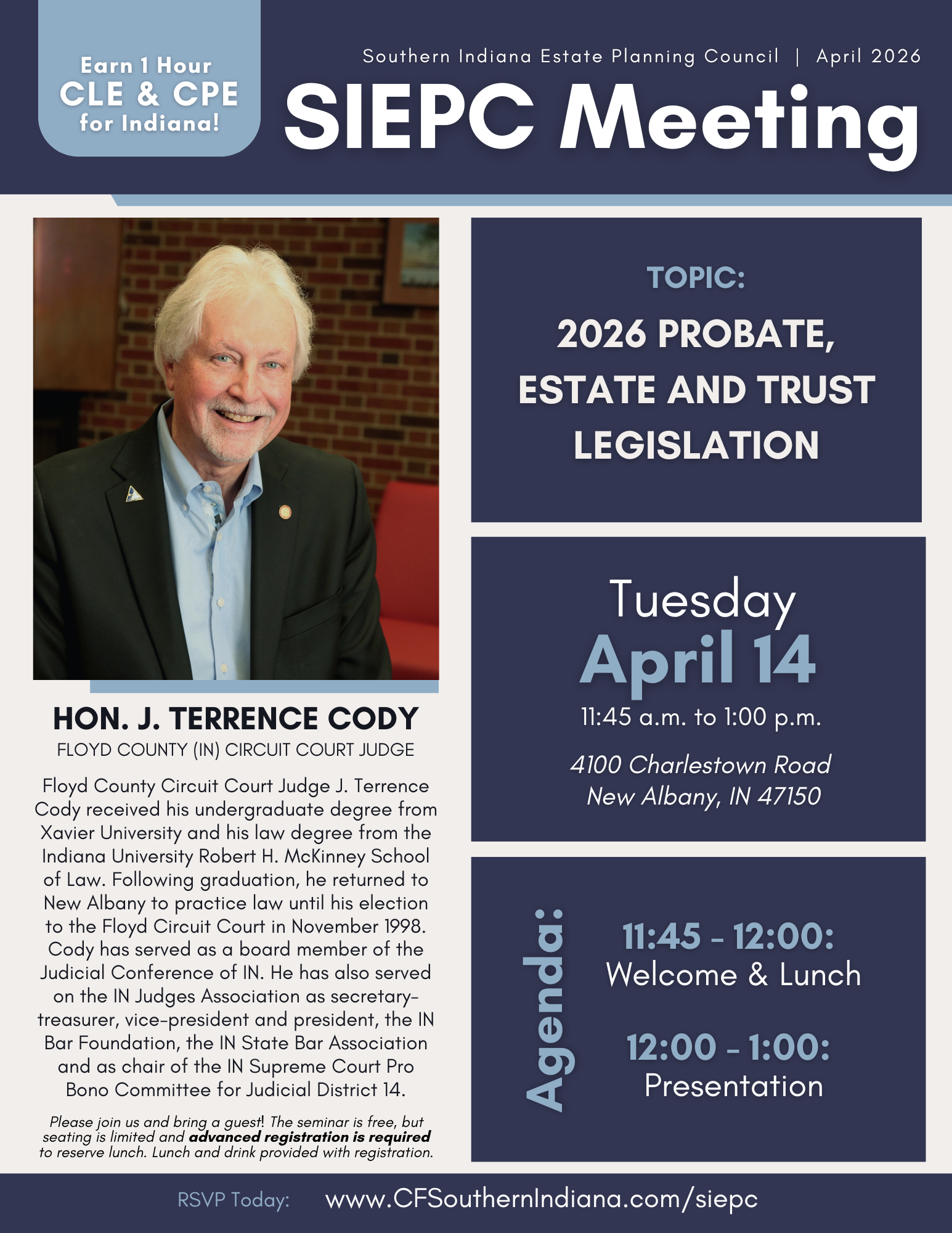
You’re invited to attend the Southern Indiana Estate Planning Council‘s final meeting of 2025-26 as our guest, which features Hon. J. Terrence Cody speaking on “2026 Probate, Estate, and Trust Legislation”.
The event will take place on Tuesday, April 14. The seminar is FREE, but seating is limited and advanced registration by Friday, April 10 is required to reserve lunch. One hour of CLE credit for Indiana is also available at no cost. Guests are welcome to attend one meeting; continued participation requires membership in the SIEPC.
Disclaimer: The Community Foundation of Southern Indiana is a resource and sounding board as you serve your philanthropic clients. We understand the charitable side of the equation and are happy to serve as a secondary source as you manage the primary relationship with your clients. This newsletter is provided for informational purposes only. It is not intended as legal, accounting, or financial planning advice.